
Grace and peace to you, from God our creator, and from Jesus, who is our Savior. Amen.
Back in the spring of 2020, Lori and I made a Target run, like many of you probably did. And what we found was something I’d never seen before. Empty shelves. No toilet paper. No hand sanitizer. And as far as basic things… things like flour and sugar. Nope. None. How many of you remember those days? (How many of you would rather forget those days?)
People were pushing carts stacked eight packages high, eyes darting around like they were smuggling gold bars out of Fort Knox.
Lori and I didn’t even have toilet paper…or hand sanitizer on our shopping list that night. But when we saw everyone else with it in their carts, we wound up buying it too.
I remember standing in the check-out lane, and thinking to myself…” ”” Man, we are not a people who trust in abundance. We are a people who trust in scarcity. Give us even a whisper of ‘there might not be enough,’ and we will empty a shelf in eleven minutes flat.
Here’s the thing. That instinct… that root fear of scarcity… it didn’t start with the pandemic. It’s something that is baked into us. Scarcity thinking is our factory default setting. We worry about not enough money. Not enough time. Not enough stuff. Not enough love to go around…if I have to share.
We hoard…we keep things…because somewhere deep down in our psyche, we believe the world runs on a limited supply, and if we don’t grab what we need now, it’ll be gone.
That’s the world that the prophet Isaiah…and for that matter, Jesus, is speaking directly into in our scripture readings for today.
Listen to how Isaiah opens. He writes, “Everyone who thirsts, come to the waters, and you that have no money, come, buy and eat.” Ok… let’s stop there for a second. That is one of the strangest invitations in the whole Bible. “Come…receive… and by the way… it’s all free!” Isaiah is basically saying, forget the economy you think you’re living in. God is running a different one. An economy of gift, not of transaction. An economy where the currency is grace, and grace never runs low…grace never runs out.
Remember the world at the time: Isaiah wrote those words to a people who had every reason to believe in scarcity. They were exiles. Their homeland was gone. Their temple was gone. Everything that told them who they were had been stripped away. And into that emptiness, God doesn’t say, “Keep what you’ve got, and ration what’s left.” God says, “Come and eat, and eat well, and delight yourselves in rich food.” God throws a banquet for people who thought they had nothing left to their name.
Now, let’s jump forward to Jesus, that day…on that hillside. He is tired…and on top of that, he is emotionally wrung out. He’d just gotten word that his cousin…and his friend…John, who we call John the Baptist…was dead. He’d been arrested, imprisoned, and then executed.
Matthew tells us Jesus withdrew to a deserted place, alone, to grieve. But the crowds found him anyway…thousands of them. And instead of sending them away so he could have his moment of solitude, Jesus looked at that overwhelming crowd and had compassion on them.
By evening, the disciples come to Jesus with what sounds like a perfectly reasonable, perfectly practical suggestion. “Send the crowds away so they can go into the villages and buy food for themselves.” That’s actually not a bad plan. That’s just good logistics. But Jesus answers with a sentence that must have made their stomachs drop. He said, “They need not go away. You give them something to eat.”
You can almost hear the disciples doing the math in their heads. Thousands of people. Five loaves. Two fish. That’s not a math problem. That’s a math impossibility. “We have nothing here,” they tell him, “but five loaves and two fish.” Notice the word: nothing. You see, when you’re living in a scarcity mindset, five loaves and two fish doesn’t look like a start. It looks like nothing at all.
But Jesus doesn’t ask them to find more. He asks them to bring him what they’ve got.
He takes the five loaves and two fish. He looks up to heaven. He blesses it. He breaks it. And he gives it to the disciples to give to the people. And somehow, impossibly, everyone eats. Everyone is filled. And when it’s all over, they gather up the leftovers. Twelve baskets full. Twelve. One for every disciple who thought they had nothing to offer.
I love this detail about the baskets. God didn’t provide exactly enough. God provided more than enough and then made sure they’d carry the evidence of it home with them.
The theologian Walter Brueggemann has written about this exact tension, the difference between what he calls the myth of scarcity and the liturgy of abundance. He argues that so much of our anxiety and our grasping comes from believing the lie that there isn’t enough to go around, when the entire biblical story keeps insisting the opposite. From the moment of creation itself, God’s first move is always generosity. God doesn’t make a world of scarcity and then hand it out piece by piece. God makes a world overflowing with more than any of us could use up. The scarcity we experience isn’t the truth of the world. It’s a story we’ve been told, and sadly, it’s a story we love to tell ourselves and each other.
That’s really what’s happening in both of our scripture texts today. Isaiah is telling exiles who believe they have nothing left, come and eat anyway, because God’s abundance doesn’t depend on your circumstances. And Jesus is telling more than five thousand hungry, road-weary people that scarcity is not the final word. It never has been. It never will be.
Here’s what strikes me most, though. Jesus didn’t make the bread and fish appear out of nowhere. He took what the disciples already had right there with them, as small as it was. He didn’t wait for them to find more. He blessed what was actually there, and then he multiplied it beyond anything they could have imagined.
I think that’s how it usually works for us too. God rarely asks us to manufacture abundance out of thin air. God asks us to bring what we’ve got, however small it feels, and trust that in God’s hands it becomes enough. Sometimes more than enough.
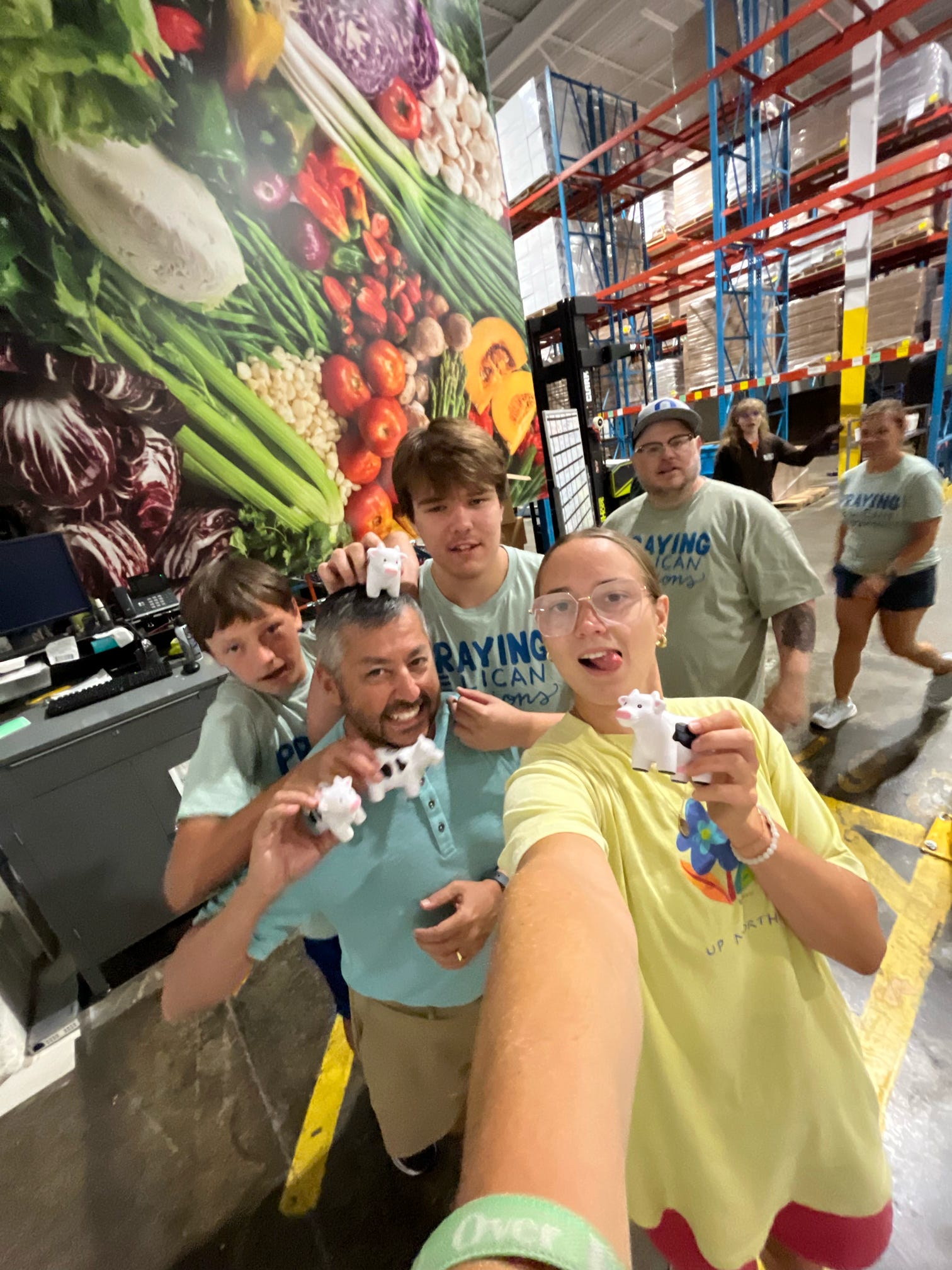
I returned home Thursday night this week from spending four days with some of Trinity’s high schoolers on their mission trip to metro Detroit. It was a great trip. And we can all be so proud of our young people. They were amazing.
And they worked hard. While we were there,
- We worked at a food bank,
- We helped clear urban lots,
- We worked in a clothing bank,
- We distributed food to folks downtown who were living on the street
- And of course we lived together, prayed together, and worshipped together.
But as is often the case, one of the most powerful moments came unexpectedly. After worship on Sunday morning at our host church, a couple, Kelly and Dan, walked up to the group and said, “We’d like to invite you over to our house this afternoon to hang out and swim in our pool.” To be clear, there is not a youth group in the world that would say no to that. So, our group spent part of the afternoon on Sunday hanging out in these kind people’s backyard… cooling off in their pool.
While there, the couple mentioned that they have new neighbors across the street. A family who had moved in with young kids. But because they had recently immigrated from the Dominican Republic, they didn’t have much stuff. Their house was pretty empty. And next door was an 81-year-old woman, twice widowed, who was moving down to South Carolina to be closer to her daughter, and she needed to get rid of some of her furniture. Dan and Kelly said that she was trying to figure out how to get her stuff moved across the street to the young family’s home. “No problem,” said our group.
So, in a spontaneous “mission trip moment,” Trinity’s young people moved a couch, a love seat, and a couple of dressers (you know, the older, heavy kind) from one house across the street to another. And while there, they met this wonderful young family: A mom, a dad, and two kids.
But that wasn’t where the story ends. During one of our group’s Target runs, they decided to do a little “extra shopping.” They bought some towels, a throw blanket, some toy cars, and Legos for the three-year-old, and a basketball for the 11-year-old. A couple of days later, our group dropped these items off at this family’s home. Gifts. From strangers. Gifts. From our high schoolers’ abundance.
Trinity’s high school group didn’t wonder if they would still have enough for themselves. They didn’t stop to do the math. They didn’t check the family’s ID. They didn’t wonder “how will this family use the stuff?” They just gave. They had met someone, built a relationship, saw a need, and then acted. This was a real-life loaves-and-fishes moment.
I think about loaves-and-fishes moments like these a lot when it comes to generosity within our own lives. It is so easy to look at what we have, whether it’s money, or time, or energy, or even hope, and think that’s not enough…not nearly enough to make a difference. But that’s exactly the scarcity story Isaiah and Jesus are both trying to talk us out of.
What if instead, we brought what we had, small as it seemed, and let God do what God has always done with small things offered in faith? Multiply them. Stretch them. Turn five loaves into a feast with baskets left over.
I don’t think God is asking us to pretend our fears aren’t real. The disciples’ fear was completely reasonable. Five thousand people and no money to buy food is a genuinely scary math problem. But fear doesn’t get the last word in this story. Compassion does. Abundance does. A God who takes what little we have and says, this is enough, gets the last word.
So here’s my invitation to you this week, the same invitation Isaiah gave a defeated, exiled people a long time ago. Come to the table. Come and eat. You don’t have to have it all figured out. You don’t have to arrive with twelve baskets already full. Bring your five loaves. Bring your two fish. Bring whatever feels laughably small, and watch…watch what God does with it.
Because in a world that keeps telling us to grab more, to hoard, to protect what little we think we have, Jesus keeps whispering something different. “There is enough,”he says. “My grace is enough. There has always been enough. There will always be enough.” And because of that grace, because of that Jesus’ love, there will always, always be leftovers.
Thanks be to God.
Amen.


Leave a Reply