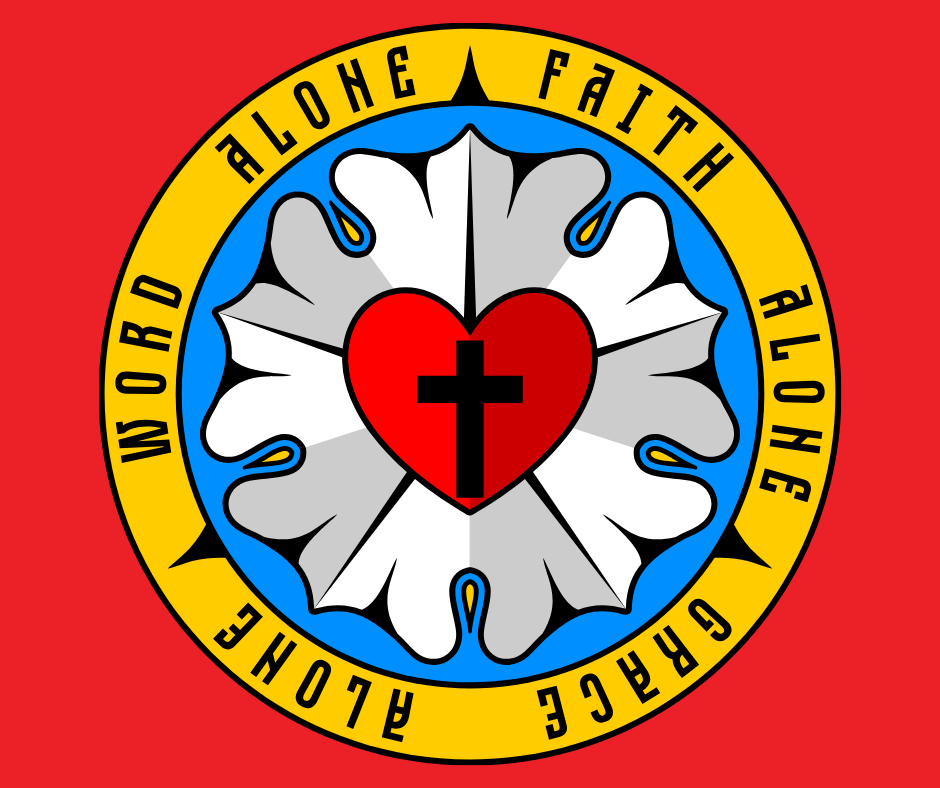
Happy Reformation Sunday!

Today the whole altar area is dressed in red. We sing a classic hymn with a tune just about powerful enough to blow the roof off the place. And we remember a German monk who changed the church…and the world… forever.
You know the old joke. How many Lutherans does it take to change a lightbulb?
Change?
I do love that joke. Because there is just enough truth in it to make it funny…and because it’s always healthy for us to laugh at ourselves.
So let me start with what actually happened on October 31, 1517, because I think the story has become muddied over time.

Martin Luther walked up to the door of the Castle Church in Wittenberg and posted ninety-five theses. (Basically, 95 complaints about the church.) Hollywood and our imagination have given us the image of Luther as some kind of revolutionary superhero with his complaints in one hand and a big hammer in the other.
In reality, that door? It was just the university bulletin board. It was where you posted things when you wanted your colleagues to see them. It was kind of the Facebook of the 1500s…without the toxicity. And the 95 Theses? Luther wrote them in Latin, which, by the way, wasn’t the language you’d choose if you were trying to start a popular uprising. It was the language you’d choose when you want to prove a point to other professors.
Martin Luther didn’t post his 95 Theses intending to split the church or found a new denomination. Not at all. In fact, he would have been horrified at the thought of church buildings like ours all over the world with his name on the sign.
No, when Luther posted his 95 Theses, he was asking the church to rethink what it believed.
But then somebody translated his theses into German so that everybody could read them. And then somebody else got them to this brand-new invention called a printing press, and the whole thing got away from Luther entirely.
But here is the part I want you to hold onto this morning. Before any of the events that made him famous, Luther wrote this: “When our Lord and Master Jesus Christ said ‘Repent,’ he willed the entire life of believers to be one of repentance.”
The entire life. Not just a single moment, or an event, or a decision. Not a day in October.
The Reformation was never supposed to be a date on a calendar. It was supposed to be a way of living.
Which brings us to our Gospel story this morning. Jesus is standing in the temple, talking to people who have just started to believe in him.
“If you continue in my word, you are truly my disciples, and you will know the truth, and the truth will make you free.”
The key word here is continue. “If you continue in my Word…”. Jesus is not saying, “If you gave your life to me once at a campfire when you were sixteen, you’re good.” He is saying continue. Stay here. Stick around. Keep listening. There is more. There is always more.
The crowd fires back: “We are descendants of Abraham and have never been slaves to anyone.”
Wait…did you say ”never been slaves to anyone?”
These are the descendants of the people whose single defining story is being hauled out of slavery in Egypt. They still tell that story every year at Passover, the same way we talk about Easter or Christmas every single year. And they are saying this to Jesus while standing in an occupied country, with the Roman soldiers standing right over there.
“Slaves? Us? Nah. That’s fake news!”
It’s all kind of funny until we recognize ourselves in it. Because if we’re honest, we do the same thing. We ignore the sin that traps us…the ego that binds us…the self-interest that builds walls. In fact, I believe the three hardest words in the English language for us to speak are the words: “I am stuck.” The people Jesus was talking to didn’t want to admit that… and neither do we.
Jesus does not argue with them. He just quietly tells the truth. “Everyone who sins is a slave to sin. So, if the Son makes you free, you will be free indeed.”
About this text, Martin Luther wrote: “…we are not yet what we shall be, but we are growing toward it. The process is not yet finished, but it is going on. This is not the end, but it is the road.”
You see, the most remarkable thing about Luther was that, as brilliant and passionate as he was, he knew that he was still being reformed… changed…every day.
Which is exactly the point.
We are not yet what we shall be, but we are growing toward it.
The phrase in Latin is Semper reformanda. It means the church is always being reformed. Always.
And if that is true of the church, it is true of you.
So let me say this as plainly as I can. You are not the finished version of yourself. Neither am I. And that is not a failure. That is the design.
The Christian life is less like a trophy case and more like a workshop. There is sawdust on the floor. Work is always being done. Something is always clamped up and drying. The Holy Spirit is not tidy, and the Holy Spirit is not done.
Which means that we need to trust…to trust in God…to trust in the Spirit, and to set aside our fears. And let’s be honest…we all have fears:
- Fears that drive us to exhaustion.
- Fears that drive us to perform instead of live.
- Fears of facing broken relationships.
- Or fears of the things you haven’t said out loud to anybody yet.
We all carry fears. Fears that we need to set down…to let go of.
Let me tell you about a night in a kitchen.
January of 1956. Montgomery, Alabama. A young pastor, twenty-seven years old, is about a month into the bus boycott and in well over his head. Late at night, while the whole family sleeps, the phone rings. The pastor answers, and a voice on the other end threatens him and his family, and then the line goes dead.
He cannot sleep. So, he gets up, puts on a pot of coffee, and sits down at his kitchen table.
And here is the thing. This is a man who grew up in the church. He is a preacher and the son of a preacher. A doctorate in theology. He could preach circles around anybody in this room. And at that kitchen table, at midnight, all he felt was fear.
So he quit performing and told God the truth. In his own words, “I am here taking a stand for what I believe is right. But now I am afraid. I’ve come to the point where I can’t face it alone.”
And in that moment he heard a voice…an inner voice…and a promise: “Stand up for justice. Stand up for truth. And I will be at your side forever.”
Martin Luther King Jr. said that in that moment, his fear left him. Now, nothing outside that kitchen got any better. In fact, his house was bombed just a few nights later. But something inside him had been changed; had been reformed, and it held him up for the next twelve years.
At that kitchen table, Martin Luther King Jr. finally said the true thing out loud: “I am afraid.” And the Spirit met him in it and did its work…and King was able to let is fear go.
You do not have to be leading a movement for this to be your kitchen table.
And here is the freedom. Once you say all of it…once you admit it…you can let it go. You can put it down. Because that’s what God promised in your baptism…because your account was settled at the cross…and nothing will ever change that.
That is what frees you to keep becoming who God created you to be! People who are stuck cannot change, because every change means admitting something was wrong. But people who already know…who are already confident that they are loved can afford to grow.
When Luther died in February of 1546, they found a scrap of paper with his handwriting on it lying next to him. Historians believe it was the last thing he ever wrote. It was not his last will; it was not a summary of his accomplishments. It was not a victory lap. It was just a piece of paper that said, “We are all beggars. This is true.”
The man who started the Reformation finished his life…still receiving…still becoming.
So today is Reformation Day. It is the day we remember these truths…the truths that set us free. So, wear the red. Sing the hymn. Love the history, all of it.
And then go home and let God keep working on you, because reformation is not an historical event; it is not something that happened to our church five hundred years ago.
It is still happening to you. Today. Right now. In your heart. God is at work.
And thanks be to God for that.
Amen.


Leave a Reply