There are some days in the life of the church when words ought to come more slowly. Good Friday is one of those days.
This is not a day for rushing. It is not a day for quick reassurance or easy optimism. It is a day for standing still long enough to see what love really looks like.
And today…Good Friday…love looks like Jesus. Standing before Pilate. Wearing a crown of thorns. Carrying a cross. Speaking words of care and mercy. Breathing his last.
We know that Easter is coming. We know the tomb will not hold him. But the church, in its wisdom, does not let us skip ahead too quickly. We pause here because the cross matters. We pause here because if we move too quickly past sorrow, we may never understand the depth of grace.
Psalm 22 gives us language for this night: “My God, my God, why have you forsaken me?” This is one of the rawest lines in all of scripture. It is not polished. It is not neat. It is the cry of a heart in anguish. It is the prayer of someone who feels abandoned, exposed, and overwhelmed.
And tonight…Jesus makes that cry his own.
That matters because it means Jesus does not save us from a safe distance. He enters the deepest places of human pain. He knows what it is to be misunderstood, mocked, and wounded. He knows what it is to suffer. He knows what it is to feel, in the darkest hour, that even God seems far away.
There is no human sorrow that Jesus has not entered into. There is no human sorrow, that Jesus does not understand.
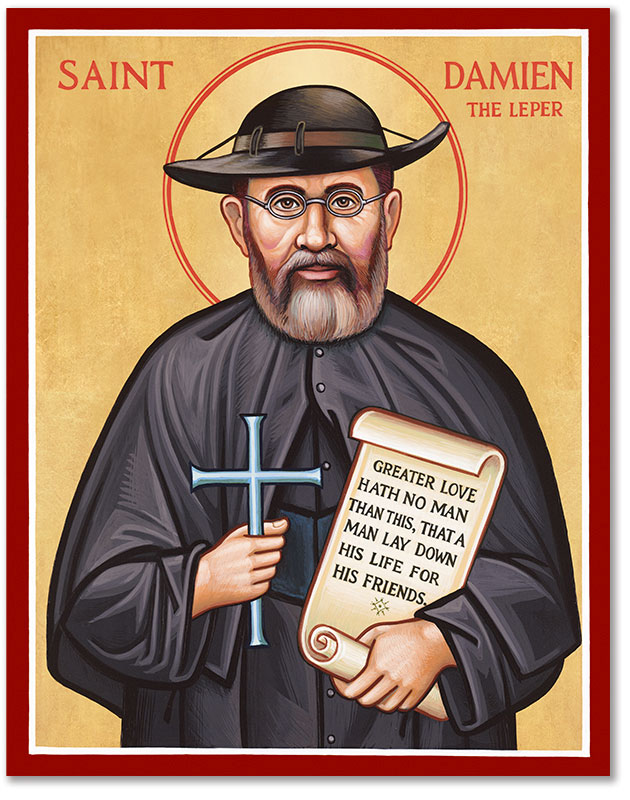
In 1873, a Catholic priest named Father Damien volunteered to travel to the remote island of Molokai and live there in a leper colony alongside the people struggling with this terrible disease. He did this, knowing that he might never return.
Father Damien did not serve them from a distance. He touched them, bandaged wounds, and built homes for them. He ate with them when others kept away. He built coffins for them when they died.
When he first arrived at the island, he had always referred to the people who lived there as “you lepers.” But over the years, as he built relationships…as he cared for them…as he shared in their experience…he began speaking of the community as “we lepers.” Father Damien died on Molokai Island of leprosy. Sixteen years after he first arrived.
Father Damien, you see, had crossed the line from helping sufferers to sharing their suffering.
This is what Jesus does. On Good Friday, Jesus steps into human suffering…and he shares it alongside us.
Jesus reminds us of an important truth: Sometimes faith is not cheerful. Sometimes faith is not strong-sounding. Sometimes faith is simply speaking your truth to God, even when your truth is full of pain.
That is one of the gifts of this day. Good Friday reminds us that God can handle grief, anger, confusion, and heartbreak. Jesus does not silence the cry of abandonment. He prays it. He carries it into the heart of God.
And then John’s Gospel shows us something else interesting. Even amid betrayal and violence, even while facing his own death, Jesus remains unfazed. He is not panicked. He remains strangely steady. He speaks with clarity. He stands in truth.
Pilate, on the other hand, seems nervous and uncertain. He moves back and forth, trying to manage the crowd, protect himself, and avoid responsibility. He wants order. He wants stability. Above all, he wants to keep his own position secure.
And in the middle of all this, Pilate asks, “What is truth?”
This is one of the saddest questions in scripture because the truth is standing right there in front of him.
But Pilate cannot bear what seeing that truth would cost him, and that makes him more familiar than we might like to admit. Most of us know what it is to compromise. Most of us know what it is to choose comfort over courage, silence over risk, convenience over conviction.
During the civil rights movement in the 1960s, a church in Cleveland was deciding whether to open its building for voter registration training. They knew it would be the right thing to do, but they also knew that it would be controversial. One member finally said, “I believe in justice. I just don’t want any trouble.”
And that is often how it goes. We want goodness, but at a safe distance. We want mercy, but without disruption. We want truth, as long as it costs someone else.
Pontius Pilate, you see, is a mirror for us. He is a frightened man protecting his place in the system. And that is exactly what makes him so recognizable.
You see, the danger for us is to imagine this as a story about bad people long ago doing terrible things to Jesus while we stand at a safe moral distance. But Good Friday will not let us do that. The passion story tells the truth about what sin does to the human heart. It shows us envy, fear, cruelty, cowardice, and self-interest.
The cross reveals the truth about humanity. The cross reveals the truth about us.
But even more, (and here is the good news) it reveals the truth about God.
The truth is…that when it feels like your life is falling apart, you do not come to a God who says, “Clean yourself up and try harder.” You come to a God who has been to Golgotha.
When guilt weighs heavily on your heart, you do not come to a God who stands at a distance with folded arms. You come to a Savior whose arms are stretched wide.
When grief makes ordinary life feel impossible, you do not come to a God who tells you to move on quickly. You come to the crucified Christ, who knows sorrow from the inside.
I once visited a woman in a memory unit at a care center. Some days, she knew who her family was. Some days she did not. On one visit, she seemed especially confused, so I asked if she would like me to pray with her. She nodded. After the prayer, she was quiet for a moment, then looked up at me, her eyes glistening. And she said, very softly, “Sometimes, I do not know where I am.” And then she said, “But Jesus knows where I am.”
That is Good Friday faith.
Not flashy. Not complicated. Just this: Jesus knows where I am.
He knows where we are when illness changes everything, when the marriage is strained, when the child is struggling, when the diagnosis comes, when regret keeps us awake at night. Jesus knows where we are. And on Good Friday, we see exactly how far he is willing to go to be with us there.
Then comes that line from Jesus: “It is finished.” Jesus says, “It is finished.”
The work of love has been completed. The mission entrusted to him has been carried through. Nothing has been held back. Jesus has gone all the way into the depths of human sin and sorrow, and he has done so willingly, faithfully, and fully.
This is why Good Friday is sorrowful, but not hopeless. We grieve, yes. We kneel in silence, yes. We feel the weight of the cross, yes. But this is not meaningless suffering. This is redeeming love.
There is a legend about a village church in Germany that had a large cross over the altar. During one particularly hard year, after crop failure, sickness, and loss, someone placed a sign beneath the cross that read, “God knows.”
God knows.
That may be the simplest Good Friday sermon of all.
God knows what betrayal feels like. God knows what grief feels like. God knows what injustice feels like. God knows what loneliness feels like. God knows what death feels like.
And because God knows, we are never abandoned, even when we feel abandoned. We are never alone, even when life grows dark. We are never beyond mercy, because mercy has gone all the way to the cross to find us.
So tonight, we do not rush past the cross. We stay here. We listen. We pray. We grieve. We behold.
And we let the cross tell us the truth. The truth about our sin. The truth about God’s love. The truth that Jesus would rather die for the world than give up on it.
And that means he would rather die than give up on you.
On this holy night, that is the mystery and the mercy we receive: Christ crucified. Love poured out. Because God knows. God knows.
Amen.



Leave a Reply