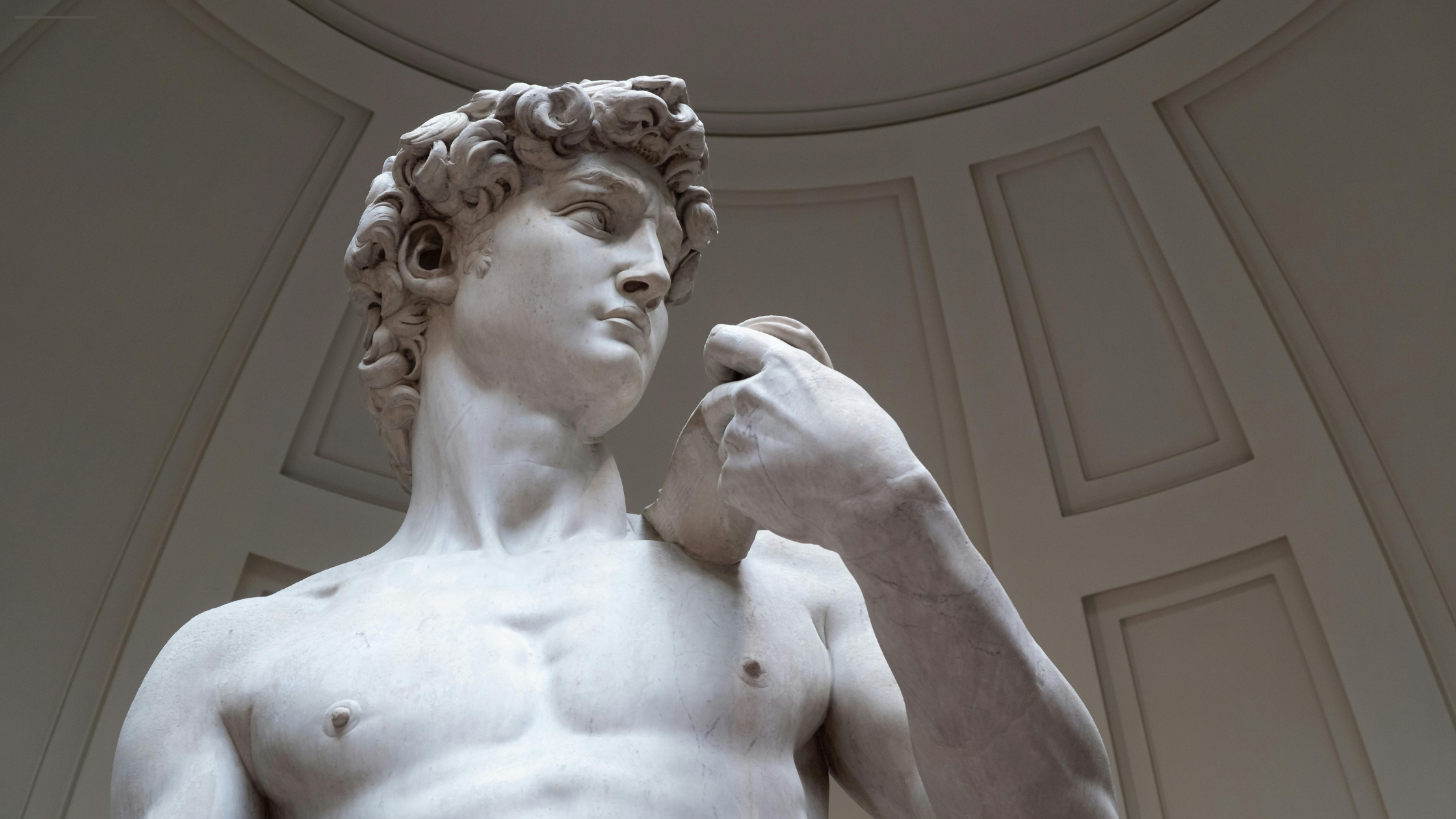
Here’s a question I want you to think about for just a moment: Not counting Jesus, who is your favorite Bible character? (You can’t pick Jesus. Everyone would pick Jesus. So, someone else)
Go ahead and think about it. I’ll wait…
Got one? Okay. I want to check a theory. How many of you picked David? I thought so.
Because if you grew up going to Sunday school…hearing the old stories…there is a very good chance that your answer is David. And even if David was not the first person on your list, I’m willing to bet that he was in your top 5.
David was the youngest brother…the overlooked one. When the prophet Samuel came to the house David and his brothers grew up in to select the next king of Israel, David’s dad, Jesse? He doesn’t even bother to call David in from the fields. Jesse lines up his other seven sons first. Seven. David is so far off his dad’s radar that he’s literally tending sheep when royalty shows up at the front door to pick the king’s successor.
But God says to Samuel, “Nope. None of these are the one. Go find the kid with the sheep.”
And then of course, David kills the giant. You’re probably familiar with the story: You know…Goliath: the famous, terrifying giant that grown soldiers are scared of. David walks up with a sling, some rocks, and a lot of determination. Apparently, he didn’t get the memo about how afraid he was supposed to be. David launches a rock. Goliath goes down. The crowd goes wild.
And David writes these beautiful songs and poetry that have been wept over for thousands of years. He dances before God with what the Old Testament describes as “all his might.”
David is the hero. Everybody loves David.
And this is exactly why what happens next is so devastating.
We are three weeks into our sermon series on Villains in the Bible. Week one: the Serpent. Week two: Pharaoh. And this week we are talking about King David. But David doesn’t sound like a villain…not at all. Right? He sounds like a hero.
Because that’s the thing about David: he is both. You see, it is easy to look at the Serpent and say: “Yeah, he’s obviously a villain…I’m nothing like that.” But David? David makes us uncomfortable. Because he had everything going for him…he’s who we admire…and he still blew it. He blew it magnificently.
Here is how it happens.
It is springtime. Our story opens with what sounds like a simple logistical detail: “In the spring, at the time when kings go off to war, David sent Joab out with the king’s men and the whole Israelite army. But David remained in Jerusalem.”
Ok. There’s a problem here. Did you pick up on it? The first sentence says “In the spring, at the time when kings go off to war…” and then the last sentence says “David remained in Jerusalem.”
Kings go to war in the spring. That is the job. That is what David has always done. Every year! The kings and their armies go out and take care of business. But this year David stays home. He sends others to do what he should be doing himself.
David decides he doesn’t need to go…doesn’t want to go. And it’s easy to guess why: David has been king for a while. And in his years of luxury, ease, and power, he develops some bad habits: Idleness, comfort, and entitlement. These are the conditions that allow for David’s worst self to emerge.
One day, he’s up on the rooftop of his royal home. He looks out over Jerusalem. And from his rooftop he sees Bathsheba bathing. She is beautiful, the scriptures tell us. She takes his breath away. He asks a servant who she is. He is told she is married to Uriah, one of his soldiers, who is off fighting in David’s war. David sends for her anyway.
Now, I need to pause here and note something important. Over time, the church has taken to reading this story as if it were some romance…some Old Testament Hallmark movie where the two characters from very different worlds find each other. This is how we have read this story. But this…this is wrong. I need to be very clear about this. This understanding of the story has done real damage. And we need to make it clear what this is. David is the king. Bathsheba is an ordinary woman…the wife of a soldier. And because of David’s position of authority, she has no meaningful ability to refuse him. What David does to Bathsheba is at best an abuse of power. The scriptures do not soften this. We shouldn’t either.
When Bathsheba becomes pregnant, David understands that this could become a problem for him. The optics are not good. So he summons her husband Uriah from the battlefield, hoping he’ll go home and well…you know…cover the pregnancy. But Uriah is faithful to his mission…to his soldiers…to his integrity…and he refuses to enjoy the comforts of home while his fellow soldiers are in the field.
And so David has him killed. He asks Uriah to carry a letter to his commander. In that letter, David orders the commander to place Uriah at the front of the heaviest fighting, then have his other soldiers withdraw… leaving Uriah vulnerable. Uriah unknowingly carries his own death sentence to the battlefield. The commander carries out David’s order. And Uriah is lost in battle.
The chapter ends with one sentence: “But the thing David had done displeased the Lord.” The thing David had done displeased the Lord.
So here is David. One of the most beloved men in Scripture. The man after God’s own heart. And God is displeased.
How does this happen to someone like David?
Well, he doesn’t begin the chapter as a villain. He begins as someone who got too comfortable. The normal checks and balances dissolved, one compromise at a time. He saw. He took. He covered up. He killed. Each step made the next one easier.
Theologian Walter Brueggemann writes that the story of David is “the story of a man of great possibility who became a prisoner of his own achievements.” The problem isn’t that David lost his faith, or anything like that. The problem is that David started believing his own press clippings. He believed he was exempt. He confused being chosen with being untouchable.
And here is where it gets uncomfortable for us.
We are not villains in the cartoon villain kind of way. No. We are people who, at our best, genuinely love God and try to live faithfully.
But…at the same time, we are people who sometimes stay home when we should show up. Who use our influence in ways we later regret. Who have been in rooms where we’ve witnessed bad things happen and haven’t said anything. We have stayed quiet.
David is not a monster. He is us on our worst day, with too much power and too little accountability.
Now, we could just let that sit. Like looking in a mirror, we can see some of David’s characteristics in ourselves. This is truth. And, we could sit here, let this truth wash over us, and feel bad about ourselves.
But this is not the end of the story.
You see, after Uriah’s death, Nathan, a prophet, walks into the throne room and says, “King David, I want to tell you about something that just happened…something I heard about.” And Nathan tells David about a rich and powerful man who takes the one beloved lamb of a poor man for his dinner rather than use one of his own sheep. Basically, he stole it. Well, David is furious. “That’s terrible!” David shouts. “That man deserves to die! Who is he?” And Nathan says: “You are the man.”
Four words. “You are the man.” And in that moment, David knew. He knew what he’d done. In his heart, he was convicted.
David doesn’t what many of us would do when confronted. He doesn’t deny…or get defensive or angry. He simply says: “I have sinned against the Lord.”
And Nathan…Nathan responds immediately. He puts his hand on David’s shoulder, looks him in the eye, and says, “The Lord has taken away your sin.”
Not eventually. Not after a probationary period. Immediately. Now. It’s done.
If you are here today and you see yourself in David, well then, you are paying attention. We all have rooftops. We all have given in to temptation, or to the belief that the rules don’t apply to us. But the God who saw David’s sin forgave it. Immediately. Completely. And God does the same for you.
And if you are here today and you are not David in this story but your story is like Bathsheba’s, then hear this: God sees you. Your suffering is not a footnote on the way to someone else’s redemption. The gospel is not only for those who need to confess. It is also for those who are waiting to be seen.
The promise we all find in this story today is that the God who sent Nathan to find David…is the same God who seeks you out. The same God who seeks you out to forgive you…and to restore you.
One of David’s most famous Psalms is Psalm 51, written after his affair with Bathsheba and the death of Uriah: David writes: “Create in me a clean heart, O God, and renew a right spirit within me.” Create in me a clean heart.
Today, like David, this is our prayer. “God…create in us a clean heart…renew in us a right spirit.”
This is our prayer… and our trust…trust that God has been waiting to do exactly that… for you.
Thanks be to God!
Amen.



Leave a Reply